LA Flash February meeting: Stateful applications and Wii installations
Animation, Events, Exemplary Work, Flash, Flex, Interactive Design, LA Flash, Wii,
2/22/08
Los Angeles-area Flash aficionados were lured out under Wednesday night’s lunar eclipse to attend the monthly gathering of LA Flash, a great local user group. Sam Rivello (whose blitting seminar I attended at last year’s LA Flashapaloozastock) gave a solid overview of various techniques for maintaining state in Flash and Flex applications, including one technique (custom namespaces) I’d never heard of before. I’d be curious to hear if anyone else out there is using custom namespaces to manage state, or for any other purpose. Afterwards I got to thank Sam for his seminar last year, as it inspired me to build a blitting engine as part of the forthcoming Precision Targets project I’m working on with Caren Kaplan.
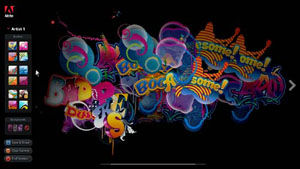
Next up was Patrick Matte of BLITZ, the interactive director behind the amazing “Creativity Conducted” multiplayer Wii remote interactive installation. Gasps of “wow” and “cool” were heard from the crowd as Patrick deconstructed the development process, which utilized WiiFlash. The biggest revelation for me (although it’s really kind of a no-brainer) was the fact that the Wiimote won’t generate mouse events; Patrick ended up using the VirtualMouse class from Senocular to connect each remote to its own virtual cursor that sent the appropriate events in response to button presses. I saw this piece on plasma screens at FITC last fall, but wish I could have seen the more immersive “holographic” version when it debuted at MAX (a new iteration is reportedly in the works for this year’s MAX). Great presentation, and great to hear from another WiiFlash user putting the server through its paces. Now if we can just get a Mac version…
TENORI-ON is happy-making
Animation, Exemplary Work, Interactive Design, Music,
9/5/07
Toshio Iwai, interactive media artist and creator of Electroplankton, gave a solo performance of his new instrument, the TENORI-ON, last night at a launch event in London. Composer Gary Kibler was there and posted a number of videos of the event. Check out the clip below—there’s a very specific joy about this device that occurs when he creates a loop and then hides it to begin work on another layer. Creating a tangible rhythm out of light, and then hiding the light while the rhythm persists… it immediately engages the maker instinct. The promise is one of building music with smart light, light that’s better than light because it remembers and holds its state in secret while you go to work on another facet of the composition. Great concept, can’t wait to see where it goes.
Source: Create Digital Music
Update: Further reflections on the device from Gary Kibler: Hands On Tenori-On: Close Encounters of the Interactive Music Kind
Recollections of “Recollections”
Animation, Exemplary Work,
8/28/07
There’s a wonderful reverberation in there. It’s the concrete floors that propagate it—reminding you that you’ve been welcomed inside an experiment, a work in progress. Even though I enjoyed the Reuben, it was carpeted, and thus robbed of that reverberation, that sound that came to represent a massive space filled with physically principled play. I assume the reverberation is still there, but I haven’t been to the Exploratorium in probably 20 years, so maybe one of you can leave a comment and reassure me that it hasn’t changed.
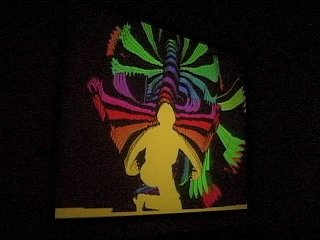
My favorite memory there is of an installation called Recollections, by Ed Tannenbaum, which I must have seen in the early 1980s. Standing in front of a large video projection, your silhouette is captured, colored, and added to the image being projected, in real time. The result is that your movements leave cycling washes of color, creating a hypnotic feedback loop between your actions and the screen’s reactions. (Ed periodically updates the piece to keep up with the technology curve.)
I remember being aware of the pixelation of the display, which makes sense, seeing as its resolution was only 256 x 240. I remember an indistinct realization that the colors were passing through the pixels—that the silhouettes weren’t actually self-contained objects, but data passing through a static grid. I remember the palette shifts that would change the whole tone of the experience, and waiting for my favorite ones to reappear. I think I was vaguely aware that the piece was running on an Apple II—the technology felt within reach. Mainly though, I remember just being really happy, and not wanting to leave. Yeah. Stuff like that would be good to make.
Thanks, Ed, that was awesome.
Recent Posts
Go InSight: Composing a Musical Summation of Every Mission to Mars (Part 2)
Making music out of the data of interplanetary exploration.
Go InSight: Composing a musical summation of every mission to Mars (Part 1)
Making music out of the data of interplanetary exploration.
Cited Works from “Storytelling in the Age of Divided Screens”
Here’s a list of links to works cited in my recent talk “Storytelling in the Age of Divided Screens” at Gallaudet University.
Timeframing: The Art of Comics on Screens
I’m very happy to announce the launch of “Timeframing: The Art of Comics on Screens,” a new website that explores what comics have to teach us about creative communication in the age of screen media.
The prototype that led to Upgrade Soul
To celebrate the launch of Upgrade Soul, here’s a screen shot of an eleven year old prototype I made that sets artwork from Will Eisner’s “The Treasure of Avenue ‘C’” (a story from New York: The Big City) in two dynamically resizable panels.
Categories
Algorithms
Animation
Announcements
Authoring Tools
Comics
Digital Humanities
Electronic Literature
Events
Experiments
Exemplary Work
Flash
Flex
Fun
Games
Graphic Design
Interactive Design
iPhone
jQuery
LA Flash
Miscellaneous
Music
Opertoon
Remembrances
Source Code
Typography
User Experience
Viewfinder
Wii
Archives
July 2018
May 2018
February 2015
October 2014
October 2012
February 2012
January 2012
January 2011
April 2010
March 2010
October 2009
February 2009
January 2009
December 2008
September 2008
July 2008
June 2008
April 2008
March 2008
February 2008
January 2008
November 2007
October 2007
September 2007
August 2007
July 2007
June 2007