BlogErik Loyer : Eloquent interactive media

Reflections on CES with TunesMap & Gracenote

Miscellaneous, Music, User Experience
1/8/11

A short aerial hop returned me home last night from Las Vegas and the human anthill that is CES. It’s been 15 years since my last visit to the show (for Inscape and Time Warner, promoting alternative graphic adventure CD-ROMs—DEVO Presents Adventures of the Smart Patrol anyone?), and while the technology on view has obviously changed, the experience of attending the show itself seems largely the same.

Trade shows are always 10,000 decibels of noisy bluster, but while E3 and Comic-Con at least have a general theme (video games, geek culture), CES is so expansive as to be nearly incomprehensible. Obviously I’m missing something, but I have never understood the utility of having such a broad swath of vendors under one roof. How does anyone find anything?

Some of my favorite booths, however, were those for international concerns whose messaging wasn’t as finely attuned to American eyes and ears as that of the typical booth barketeers. The pleasure of ingesting content not engineered precisely for you is one I’m learning to appreciate more as I get older, I think.

Browsing time was limited, however, as my main reason for attending the show was not to buy, but to sell. For the last two years I’ve been working with a startup called TunesMap, brainchild of longtime music supervisor G. Marq Roswell and a small team of music and media professionals, developing UX for a music discovery engine with two main differentiators: 1) delivery of cultural context with music search, in the form of audio-visual search results that integrate the requisite artists, albums and songs with the films, fashion, news, literature, art and comedy that were contemporary with the music’s creation and 2) a deep editorial bench of music experts who can help weave this cultural tapestry out of their own expertise and personal experience (the stories one hears from these guys is one of the most fascinating perks of the job).

Gracenote, creators of CDDB (which is the reason why iTunes magically knows all about the tracks on that CD you’re ripping), is expanding their already impressive reach providing metadata for the worlds of music and entertainment. Seeing TunesMap as complementary to those goals, they kindly invited us to share their booth. As of this writing CES is still ongoing for two more days, but already the response has been very strongly positive.

For me personally the show has also been a great experience—the TunesMap team has been working in largely virtual fashion and it’s always great to see everyone in person. In addition, we’ve been showing the extensive mockups I’ve helped put together for TunesMap and received many positive comments on the UI, which is encouraging. During my last really sustained run at the tech trade shows I was also at a much more junior phase in my career, so it has been fascinating to see the phenomenon this time from a “back room” perspective. The ritualistic nature of deal-making never ceases to fascinate.

I think ritual also holds the key to some of the strangeness CES holds for someone working in the world of UX, which has been so profoundly shaped by Apple over the last decade. As Apple’s dominance in digital culture has increased, so too has it’s particular sheen of design, marketing and presentation. On the dog-eat-dog world of the CES show floor, both the foreign feel of alternate marketing styles and the incessant copycatting of Apple’s recent successes points up exactly how much we’ve been entrained to step in time with the rhythms of the makers of “those fruit computers.”


Precision Targets launches; interactive comic and essay within a navigable cube

Animation, Announcements, Comics, Digital Humanities, Flash, Flex
4/29/10

Screenshot from Precision Targets

A screenshot from Precision Targets.

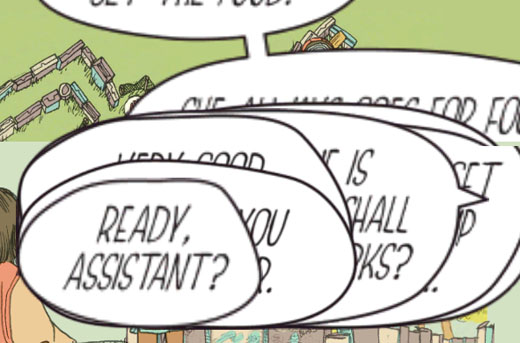
It’s been a long time in coming, but I’m very happy to announce the official launch of Precision Targets, a collaboration with scholar Caren Kaplan that uses a hybrid comic/essay format to explore the militarization of everyday life through technologies like GPS. Precision Targets places the user inside a cube containing six parallel stories told through interactive comic panels that are married to threads of commentary by Kaplan.

Precision Targets was my first collaboration with illustrator Ezra Claytan Daniels, and my first experiment with digital comics. Each story consists of four panels which can be browsed by rotating a cube. Individual panels (some of which contain animation and interactivity) can be entered and navigated with the mouse. Every panel has associated commentary by Kaplan which can be expanded by clicking “more”. Clicking “more” again further expands the commentary to a full-screen view for more in-depth reading, making it possible for users to switch between visual, textual, or hybrid reading modes at will. (Be sure to try adjusting the window size; the piece will adapt to whatever aspect ratio you like.)

One element of the project that can be easily missed is the Index, a force-directed SpringGraph visualization of the image and textual elements that make up the piece (you can access this feature by clicking “Menu” and then “Index"). You’ll see the individual graphic elements that make up each panel linked together in an interactive network diagram—to my knowledge, the first time a visualization like this has been applied to the individual layers of comic book panels (feel free to correct me if I’m in error).

This project was conceived before the current “motion comics” trend, so I’m very curious what people will think of the approach, which takes a different tack than most works labeled as such.


Tag-team talk with Craig Dietrich at USC’s Digital Studies Symposium

Digital Humanities, Events, Interactive Design, Music
3/3/10

Moderated by Freewaves founder Anne Bray, the Digital Studies Symposium at USC (open and free to the public on Thursday evenings) has been hosting weekly conversations between pairs of digital designers about the myriad, ever more swiftly flowing currents of the digital humanities. Anne was kind enough to invite my Vectors collaborator Craig Dietrich and myself down to the Zemeckis Center to speak on February 11th, and video of the talk has been posted to Vimeo (see below). There’s also a video archive of all the prior speakers on the DSS site.

Digital Studies Symposium 2_11_10 (1 of 3) from IML @ USC on Vimeo.

Digital Studies Symposium 2_11_10 (2 of 3) from IML @ USC on Vimeo.

Digital Studies Symposium 2_11_10 (3 of 3) from IML @ USC on Vimeo.


Thank you, Anne Friedberg

Digital Humanities, Remembrances
10/16/09

I wanted to take a moment to acknowledge Anne Friedberg, a brilliant scholar I had the privilege of collaborating with on a project called “The Virtual Window Interactive,” a companion piece to her book The Virtual Window: From Alberti to Microsoft. Anne passed away a week ago today.

In the brief time during which I worked with Anne, I found her to be not just a brilliant thinker, but a wonderful collaborator with an infectious enthusiasm for the potential of the field. “The Virtual Window Interactive” was one of those rare projects which almost seemed to design itself, as if the ideas Anne had been exploring were anxiously awaiting just this kind of outlet. The inherent visual qualities of Anne’s subject matter, the excitement she had for the medium, and the depth and clarity of her analysis made the project a real pleasure to develop.

Most of our real-time contact during the project was via three-way videoconferences between Anne, Steve Anderson (who orchestrated our meeting and facilitated the project) and myself. I had a habit of taking screenshots during these calls, and thought I’d share an image of one of our lighter moments (see below). I remember Anne being intrigued by the “windows” of the videoconferencing interface itself; throughout the development of the project she was keen to stay abreast of the dizzying changes happening in screen space and wanted the piece to speak to those changes as much as possible.

Others have reflected more thoroughly on the breadth of Anne’s considerable contributions to her field and the positive impact she had on those who knew her personally. I didn’t know Anne well, but I’m grateful for even the brief chance I had to work with such a remarkable person. Thank you, Anne.

Anne Friedberg, Steve Anderson and I on a videoconference during the production of “The Virtual Window Interactive.”

Anne Friedberg, Steve Anderson and I on a videoconference during the production of “The Virtual Window Interactive.”


Pictures at an exhibition: Blood Sugar at UCLA

Digital Humanities, Events, Flex, Wii
2/1/09

Just wanted to share a few snapshots taken just prior to the opening of the installation of Blood Sugar at the UCLA Art | Science Center (the exhibit runs through February 20). The event went quite well—people seemed to really be engaging with the content of the piece, and we got lots of positive feedback about the use of the Wii remote and nunchuk as controllers. “Feels like Minority Report,” one visitor commented.

One interesting tip that might be of use to other folks wanting to create Wii remote-driven installations using the sensor bar: we found that stacking two sensor bars one on top of the other resulted in significantly more reliable pointer control.

Image of the Blood Sugar installation.

Just before the opening.


Image of the Blood Sugar installation.

You can see the two stacked sensor bars here.


Image of the Blood Sugar installation.

A DVD station provides context for the piece.


Page 2 of 14 pages  <  1 2 3 4 >  Last »