The slabtype algorithm, Part 2: Initial calculations
Algorithms, Flash, Graphic Design, Interactive Design, Typography,
1/24/08
This is the second in a four-part graphical dissection of the “slabtype” text layout algorithm I developed for Public Secrets. For an introduction to the algorithm, visit The slabtype algorithm, Part 1: Background.
Execution of the slabtype algorithm breaks down into three phases: initial calculations, iterative line splitting, and final layout. In this post, we’ll tackle the initial calculations that set the stage for the work of the algorithm.
Three constants are used to constrain the results of the initial calculations. The first is the average aspect ratio of a single character of the font we plan to use (Alternate Gothic No. 3, in this case). This is important because it gives us a way to guess how wide a particular line of text is going to be without consuming precious time by actually laying it out. I looked at a selection of characters from the font and estimated the aspect ratio accordingly.

Next, I decided upon a character count for the “ideal line length” of text to be fit into the slab. Since I used the “squarified” variant of the treemap algorithm to generate the enclosing boxes, I could be confident that a fixed value would give good results, but a more truly dynamic implementation would derive the ideal line length from a pixel value for the average height or width of a single character in the ideal point size for the display.

We multiply the average character aspect ratio by the ideal line length to arrive at an aspect ratio for the “ideal line”:

These constants are defined once at the beginning of the program. The calculations which follow are executed each time the algorithm is invoked.
We start with the text which the algorithm is tasked with laying out.

The algorithm is then supplied with the dimensions of the slab (box) into which the text is to be placed:
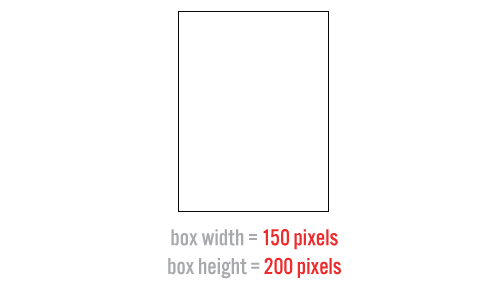
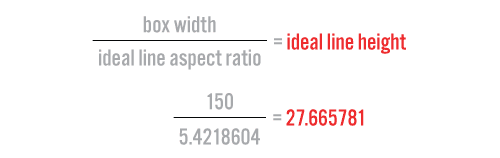
We divide the width of the box by the aspect ratio of the “ideal line” of text which it is to contain, resulting in a pixel value for the height of this line.
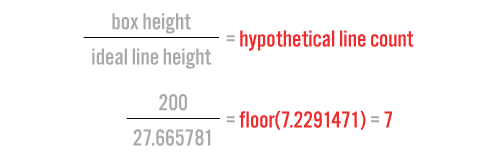
When we divide the height of the box by the height of the ideal line, we arrive at a hypothetical line count—an estimate of how many lines the text is going to have to be broken into to fit snugly within the box.
Since we know the number of characters in our text, we divide it by our hypothetical line count to come up with an “ideal character count” per line of text.
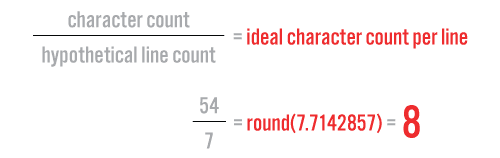
As we will see in the next part, this is a very important value—it becomes a benchmark to help us decide where to split the text into lines.
Coming soon: The slabtype algorithm, Part 3: Iterative line splitting
Recent Posts
Go InSight: Composing a Musical Summation of Every Mission to Mars (Part 2)
Making music out of the data of interplanetary exploration.
Go InSight: Composing a musical summation of every mission to Mars (Part 1)
Making music out of the data of interplanetary exploration.
Cited Works from “Storytelling in the Age of Divided Screens”
Here’s a list of links to works cited in my recent talk “Storytelling in the Age of Divided Screens” at Gallaudet University.
Timeframing: The Art of Comics on Screens
I’m very happy to announce the launch of “Timeframing: The Art of Comics on Screens,” a new website that explores what comics have to teach us about creative communication in the age of screen media.
The prototype that led to Upgrade Soul
To celebrate the launch of Upgrade Soul, here’s a screen shot of an eleven year old prototype I made that sets artwork from Will Eisner’s “The Treasure of Avenue ‘C’” (a story from New York: The Big City) in two dynamically resizable panels.
Categories
Algorithms
Animation
Announcements
Authoring Tools
Comics
Digital Humanities
Electronic Literature
Events
Experiments
Exemplary Work
Flash
Flex
Fun
Games
Graphic Design
Interactive Design
iPhone
jQuery
LA Flash
Miscellaneous
Music
Opertoon
Remembrances
Source Code
Typography
User Experience
Viewfinder
Wii
Archives
July 2018
May 2018
February 2015
October 2014
October 2012
February 2012
January 2012
January 2011
April 2010
March 2010
October 2009
February 2009
January 2009
December 2008
September 2008
July 2008
June 2008
April 2008
March 2008
February 2008
January 2008
November 2007
October 2007
September 2007
August 2007
July 2007
June 2007